

Helping students and families better understand the college application process
Beaver Basics
College Application Basics
It is never too early to start thinking about continuing your education after high school. Whether you know you are college-bound or are still weighing your options, it is important to understand the next steps towards a college education.
At its most basic level, a college application tries to find out who you are, so colleges can determine if you will be successful at their school. While that question may be easy to ask, it is actually quite hard to answer because of how complex we all are as human beings. Because of this, college applications are fairly long in an effort to get a full picture of you both as a student and as a person. Since it can be lengthy, you will want to begin your application far ahead of time to make sure you have enough time to write and edit your essay, get your transcripts sent to the school, and anything else that may slow you down. Plan ahead and do not wait. Think of it less like a job application and more like a big school project that you will need to come back to a few times.
When to start your application and apply:
- You should plan to apply to colleges between the beginning of your senior year and New Years.
- Most college application deadlines are sometime in January and February, but you will want to make sure to check each school's specific deadline dates.
- For example, OSU's application deadline is February 1st.
Parts of the College Application
Along with the basic information like name, address, and what school you go to, colleges want to know lots of weird information that may seem irrelevant to you. Things like gender, race, and sexuality — for example — can come off as especially strange things that a college wants to know about you. However, this information is very important to colleges like OSU. We ask these questions so that we can identify students who wish to learn more about services and scholarships available to them at their future college. This makes for a more inclusive campus that helps to support historically marginalized groups.
The largest and most important part of your college application is your college application essay. Depending on the college, this may be one long essay (like OSU) or multiple shorter essays. When you are writing the essay, you will usually be given a prompt like you would see in an English class. Make sure to address all parts of the prompt and connect them to your academic interests if you can!
For example purposes, here is one of OSU's prompts:
- The lessons we take from obstacles we encounter can be fundamental to later success. Recount a time when you faced a challenge, setback, or failure. How did it affect you, and what did you learn from the experience?
Be sure to proofread your essay, read it out-loud to yourself, and/or have someone else like a teacher or parent proofread it as well.
One of the easiest and most valuable parts of your college application is your activities list. You should include anything and everything that would help a school get a better picture of who you are outside of the classroom (if it takes time away from studying or class, add it to your activities list).
As we like to say at OSU, "If it matters to you, it matters to us"
Even if you were on homecoming committee three years ago, we still want to know about it! Be sure to include the things you were responsible for, how much time you spent doing the activity, and assume that we have no idea what you are talking about (acronyms, for example, can be confusing since colleges will not know what they stand for).
Your transcript is a record of all the grades you have earned while in high school. You will typically submit this before you finish your first semester of your senior year — or trimester, depending on your school. This means that your application will be evaluated based on your first three years of high school. So, if you're considering waiting to take that AP Bio class until senior year, it may be better to take it now so colleges can see that you are pushing yourself.
FAFSA - What is it?
FAFSA is how the majority of Oregon State Students are at least partially funding their education. It stands for the Free Application for Federal Student Aid, and it is an application that you fill out with the federal government to receive things like:
- Loans
- Grants
- Work Study
Loans are money that you will need to pay back after you graduate from college. You may have heard these referred to as ‘Student Loans’. Grants are money given to high-achieving or high-need students that do not need to be paid back. Work Study is quite a bit different. Work Study is money that you can earn by working a student job on the college campus. Instead of the money being given to you in the form of a check, the money goes straight towards your tuition.
Find out more about Financial Aid at OSU.

Living on a College Campus
Living on a college campus can be both the most exciting and most terrifying part of leaving home to go to school. Schools like Oregon State require you to live on campus your first year. Other schools may require you to stay on campus for all four years or may not require it at all. However, don’t let this get you down! Living on campus isn’t only a great way to make lifelong friendships, it also helps you stay focused on school. Research shows that the first year-students who live in the residence halls are more likely to have a higher GPA at OSU than those who live off campus.
Living on campus can also make the transition to adulthood easier by simplifying some of the day-to-day stressors of adulthood like buying and preparing food, finding roommates, and commuting to school. When you live in the residence halls, that is all taken care of for you so you can focus on the important stuff like studying for that big test or finding that perfect club on campus.
Learn more about housing at OSU.
Choosing a College
Choosing a college is all about finding the right fit for both your academic and personal goals. Your academic goals may be tied to a specific job field or a degree title, while your personal goals may be about meeting people or getting involved in activities.
Here are some things to consider and questions to ask yourself when you’re deciding between colleges:
- Size: Is this a large public university or a smaller private college?
- Location: Is it a large city or a small town?
- Distance from home: How hard will it be to go home for the weekend?
- Available majors and classes: Does this college offer the major I'm interested in?
- Housing options: Can I live on campus?
- Campus atmosphere: Does it feel like somewhere I want to spend 4 years?
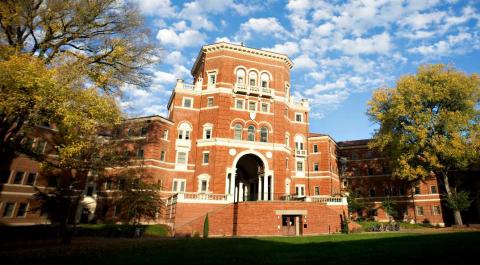
If you'd like to see what a classic college campus looks like, take a virtual tour of OSU's campus.

Writing the Perfect College Essay
Not only is the college essay a place to showcase your writing skills, but it’s also one of the only parts of a college application where a student’s voice can shine through. Unlike any SAT/ACT scores or your transcripts, the college admission essay offers students a chance to showcase your personality. The essays are important in part because this is a student's chance to really speak directly to the admissions office.
There are usually several essay prompts to choose from on a college application. They tend to be broad, open-ended questions, giving students the freedom to find a way to fit their story into the prompt. College essays vary in length by school, but most will fall between 500-1000 words. At OSU, there is no word minimum (only a word maximum). This lets you make sure you are submitting a great piece of writing and not extra content to meet the word count requirement.
Tools for Writing Your College Essay
Prompt: The lessons we take from obstacles we encounter can be fundamental to later success. Recount a time when you faced a challenge, setback, or failure. How did it affect you, and what did you learn from the experience?
Word count: 541
I have always loved winter sports. By the age of 8 I was already out hitting the slopes with my family every weekend; I even taught my two younger siblings how to ski when they were young. However, my love for winter sports was challenged after I had a bad accident two Februarys ago while visiting Hoodoo Ski Area outside of Sisters, OR for a family vacation.
When we first arrived at the ski area, I could barely hold in my excitement! I quickly strapped on my boots and found my way to the ski lift so I could be the first person on the fresh powdery snow that had fallen the night before; a dream for any avid ski enthusiast. But, only thirty minutes into what appeared to be the perfect day I made a big mistake that would put my love of skiing, and my life, in jeopardy.
If you have never heard the horror stories of skiers falling into tree wells, then you have been spared a truly nightmare-inducing tale of isolation. A tree well, as defined by Wikipedia, is “the space around a tree under its branches that does not get the same amount of snow as the surrounding open space”. This may sound innocent enough, but what the definition doesn’t mention is the dangers these pose to winter sport enthusiasts. If a skier gets too close to one of these tree wells, they are susceptible to falling into the loosely packed snow and becoming stuck upside down without a way to call for help. This often leads to death.
When I first struck the tree that morning, the wind was instantaneously knocked out of me and I became disoriented. Little did I know, that would only be the beginning of my troubles. By the time I realized what was happening, I was upside down in a tree well with my arms pinned by my side and my legs mangled against the rough bark of the tree.
I had always heard stories about tree wells, but laughed at the idea and assumed it could never happen to me. Thinking through what I should do, I was reminded of the lackadaisical mindset I had approached this topic with before and didn’t know where to begin. I thought I was doomed.
Lucky for me the slopes were fairly busy that day due to the very powdery snow that created the tree well I was stuck in. A rescue team was able to help free me within a few minutes and get me to the bottom of the hill to the paramedics. I am still very thankful for their rapid response and kindhearted remarks as they got me to safety.
In the coming weeks as my cracked rib and sprained ankle healed, I found myself wondering if I would ever feel safe enough to ski again. I expressed this concern to my physical therapist and they reassured me that if I wanted to, I would be completely able to ski again. They showed me how my ankle moves in the joint and that spurred my interest in Kinesiology. I want to attend Oregon State University so I can help people regain their love of sports after an accident like mine.
- Captivating hook
- Focused topic
-
Organized Structure
- 1/3 narrative storytelling, 2/3 reflective analysis
- Clear beginning, middle, and end
- Stick to a linear storyline (don't jump around)
- Personal yet appropriate tone
- Sincerity and authenticity
-
Sound grammar and proper spelling
- While you are not going to be admitted or denied admission based on your grammar, it demonstrates strong attention to detail and shows effort was put into the essay when you use good grammar.
- Take time to brainstorm and start by getting your ideas on paper.
- Hook the reader, pull them in, and give them a reason to keep reading.
- Give yourself options with whichever prompt you select - don't force it to fit your story.
- Don't select too big of a story to tell. It's better to stretch a short story than to compress a longer story.
- Think about what drives you to do what you do or what makes you want to do what you want to do.
- Avoid bragging - think of your college admission essay as a chance to provide a "behind the scenes" glimpse into who you are.
- Show your personality - it's not about the topic, it's about how it pertains to you!
- When in doubt, take a break. Writer's block is real - take a walk, watch an episode of a show, or listen to some music.
- Ask your favorite teacher to read your essay for you.
- Read your essay out loud to help catch things that don't sound natural.
- Some students have a background, identity, interest, or talent that is so meaningful they believe their application would be incomplete without it. If this sounds like you, then please share your story.
- The lessons we take from obstacles we encounter can be fundamental to later success. Recount a time when you faced a challenge, setback, or failure. How did it affect you, and what did you learn from the experience?
- Reflect on a time when you questioned or challenged a belief or idea. What prompted your thinking? What was the outcome?
- Reflect on something that someone has done for you that has made you happy or thankful in a surprising way. How has this gratitude affected or motivated you?
- Discuss an accomplishment, event, or realization that sparked a period of personal growth and a new understanding of yourself or others.
- Describe a topic, idea, or concept you find so engaging that it makes you lose all track of time. Why does it captivate you? What or who do you turn to when you want to learn more?
- Share an essay on any topic of your choice. It can be one you've already written, one that responds to a different prompt, or one of your own design.